
Use media to support interaction, not replace it
Phones, tablets, cameras, and QR codes can be genuinely helpful when they point adults back toward shared songs, shared books, and shared experiences.
The goal is not more screen time. The goal is easier access to songs, easier family participation, and better ways to make print and music portable.
Technology Together
Use your own photos to make simple little song books for home or classroom use.
QR Codes
Help families jump from a printed page directly to the matching song or video.
Printable Books
Find the printable books and take-home pages that connect technology, songs, pictures, and shared reading.
How Technology Connects — and Disconnects
Long before a baby is born, technology impacts its life. But like a well-sharpened knife, it can help or it can cut. The first step in managing our new world is being aware of all the ways technology impacts our children's lives — only then can we make intentional choices about how to use it responsibly.
| Technology | How It Can Connect | How It Can Disconnect |
|---|---|---|
| Baby Monitor | Keeps baby safe; lets you hear your baby's voice, babbling, singing, and talking. | Thinking your child doesn't need you because he's not crying. Playful, awake time is optimal learning time. |
| Toy with Electronic Melody | Use with your baby — move from side to side to encourage eye tracking and following sound. Talk about it together. | Left with baby to discover alone. Although baby will respond to the sound, it's really just sound — not music. |
| Electronic Toys for Babies | Play with baby, showing how to push a button to make lights or sound work — get excited when baby does it. | Showing baby once how the toy works, then leaving baby to play alone. |
| Cell Phones | Minimal use, especially texting. Children need and want to hear your voice — just hearing it gives your child a wealth of information. | Continually texting or watching the screen. When children talk to parents who are texting, there is little eye contact and minimal oral language shared. |
| Apps on Mobile Devices | Apps that teach letters, numbers, patterns, or finding games — with an adult sitting alongside offering comments. | The "passback effect" — handing a device to a child simply to keep them busy. |
| Tablets & E-Readers | Answering questions when the child is most curious. Interactive e-books, or family photo books made with free apps. | Simple repetitive games with minimal choices, or using the device regularly just to keep the child occupied. |
| DVDs | Age-appropriate and occasional — best shared as a family so you can discuss as you watch. Fine for long car trips as a special occasion. | Putting it on whenever you're in the car creates distance and eliminates one of the best conversation times. Watching so often that a child expects or demands a movie. |
| Television | Limited watching of age-appropriate shows, with adults present. Watching and discussing together builds vocabulary and storytelling skills. | TV on all the time or more than it is off; TV in a child's room; unmonitored viewing of age-inappropriate shows. |
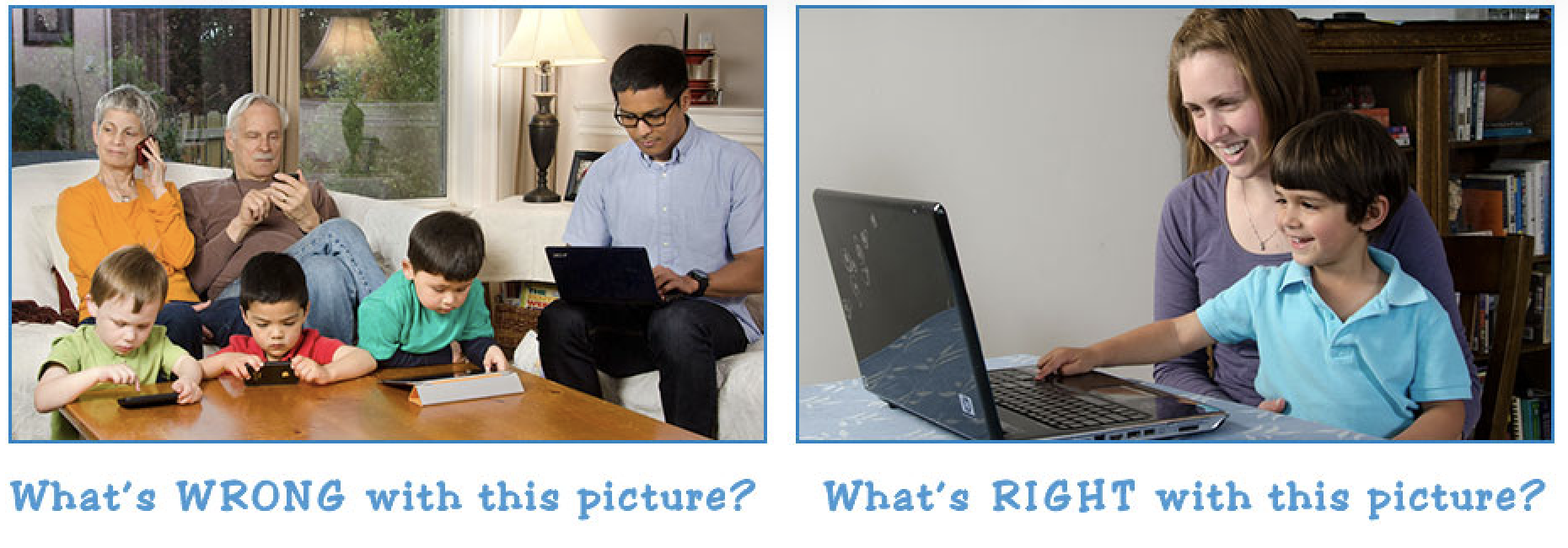
| Computers | Sitting with your child to look at digital photos of family and friends, reading together, playing together, or video calling relatives. | Sitting a child at a computer with a simple button-pushing game and walking away — using it as a babysitter. |
| Music Players | Singing and dancing along, or using music as a comforting bedtime ritual that helps children self-soothe. | Volume too loud for young ears; music inappropriate for children; music on constantly until it becomes white noise that leaves no space for talking or singing. |
The Other Side of Screen Time
By Nancy Stewart
Much has been researched and written about young children and how much screen time they should be allowed at different ages. But what's not being written about is the other screen time — adults watching a screen while caring for young children. Last year I took my two young grandchildren to the park where there were a dozen or so other adults with their children. I suddenly realized I was the only adult actually watching the children, and I started thinking about the consequences of "the other side of screen time."
Don't get me wrong. I love my iPad and my smartphone and my computer — all of which allowed me to create this project. But with this technology comes huge responsibility. Here are my thoughts on what's not happening with our children while we are on our phones, pads, televisions, and other screens.
Brain connections. Babies and young children learn new things constantly throughout their day. When they discover something new, the first thing they do is look to their adult for a reaction. It is in that split second — when the adult reacts — that connections are made. These connections build the wiring in the brain. What happens when a baby keeps looking to its parent and no one is looking back?
Face time. Children learn empathy by watching the expressions on our faces. At six months they watch our lips as they begin to figure out sounds and speech. The more they see and hear us, the more they learn about language and human emotion.
Talk time. Babies and young children love the sound of your voice, and the more they hear it the more they engage and learn. The amount of talking to babies and conversing with toddlers may be the single biggest factor in reading success later on. Adult screen time is time spent not talking.
What you're missing. When you are in the same room with your baby but focused on a screen, you are missing the best entertainment ever — a human being discovering its world for the first time. Miraculous things happen constantly, in the blink of an eye.
Safety. At the park that day I realized how easy it would have been for a small child to suddenly disappear. It's hard enough to keep your eyes on your own child in a sea of motion, let alone if you look away for five or ten or twenty minutes.
It's not complicated, but it's vitally important. To raise happy, healthy, smart children, we have to be present — not just physically present. And that brings me back to singing. Singing is free. It's available to every one of us, regardless of income or education. When we sing with our children, all of the things that should be happening can and do. So the next time you're caring for a baby or young child, try putting down your device and just sing. You'll be glad you did — and so will your child.